
Read about NNSA's efforts to prevent nuclear proliferation.
Preventing nuclear weapons proliferation and reducing the threat of nuclear and radiological terrorism around the world are key U.S national security strategic objectives that require constant vigilance.
NNSA's Office of Defense Nuclear Nonproliferation (DNN) works globally to prevent state and non-state actors from developing nuclear weapons or acquiring weapons-usable nuclear or radiological materials, equipment, technology, and expertise.
Read more about the office's work in the DNN Sentinel.
DNN carries out its mission through the following strategic activities:
Learn how NNSA protects radioactive sources worldwide.
The mission of the Office of Global Material Security (GMS) is to prevent terrorists from acquiring nuclear or radioactive material that could be used in an attack on the United States, its interests, or allies. GMS works with partners worldwide to secure nuclear and radioactive material and to detect and deter trafficking of this material.
There is enough nuclear material around the world to make tens of thousands of nuclear weapons, and there are large quantities of radioactive material that could be used in a radioactive dispersal device or “dirty bomb.” The detonation of such a device could cause death, injuries, widespread panic, and mass evacuations.
GMS protects the United States by working overseas to provide partners with the capacity to secure nuclear and radioactive material and stop smuggling efforts. Domestically, GMS helps partners secure and eliminate radioactive materials to prevent their theft and use against the homeland.
International Nuclear Security
INS advances U.S. international efforts to prevent theft and sabotage of nuclear materials and facilities worldwide by partnering with countries and international organizations to secure weapons-usable nuclear materials, nuclear power plants and fuel cycle facilities, research reactors, and materials in transit.
Radiological Security
Works with government, law enforcement, and businesses across the globe to protect radioactive sources used for medical, research, and commercial purposes; remove and dispose of disused radioactive sources; and reduce the reliance on high-activity radioactive sources through the promotion of viable non-radioisotopic alternative technologies.

Trucks pass through radiation portal monitors along Bulgaria’s border with Romania. The monitors allow automated, 24-hour screening of traffic at points-of-entry, detecting the presence of radiation in persons, vehicles, and cargo.
Nuclear Smuggling Detection and Deterrence
Works with international partners to strengthen capabilities to detect, disrupt, and investigate the smuggling of nuclear and radioactive materials by providing the expertise and tools needed to respond to smuggling events.
A critical step in the development of an improvised nuclear device is acquiring weapons-usable nuclear material. NNSA’s Material Management and Minimization program reduces the risk of hostile states and non-state actors acquiring nuclear material for an improvised nuclear devised by working with partners to minimize the need for, presence of, or production of weapons-usable nuclear material around the world.
Convert
The first step to minimizing the use of weapons-usable nuclear material is to eliminate the need for and availability of the material. NNSA accomplishes this through the Convert Program, which works primarily at civilian research reactors and medical isotope production facilities in the United States and around the world.
Facilities that use weapons-usable material cooperate with NNSA and experts from the National Laboratories to convert their highly enriched uranium (HEU) fuel and targets to low-enriched uranium (LEU), a material that cannot be used in a nuclear weapon. We are also working to develop and qualify new LEU fuels for some of the most complicated reactors around the world that cannot convert using existing LEU fuels. NNSA's Proliferation Resistance Optimization (PRO-X) works with reactor designers to help improve proliferation resistance in facilities around the world.
As part of its HEU minimization mission, NNSA manages the Molybdenum-99 (Mo-99) Program. Mo-99 is an isotope that is used in over 40,000 medical procedures in the United States each day. The decay product of Mo-99, technetium-99m (Tc-99m), is the most commonly used radioisotope, relied upon for performing heart stress tests, identifying cancer throughout the body, and studying organ structure and function. The Mo-99 Program assists global Mo-99 production facilities in converting to non-HEU processes and supports the establishment of domestic supplies of Mo-99 without the use of HEU.
Remove

The Office of Nuclear Material Removal works to reduce the risk of a terrorist or other malevolent actor acquiring HEU or plutonium for use in an improvised nuclear device. The office works with partner nations and international institutions around the world to identify excess nuclear material and implement permanent solutions to consolidate, remove, and/or dispose of these inventories. The office also maintains the capability to carry out expedited nuclear material removals should the need arise.

Dispose
The Surplus Plutonium Disposition program is responsible for disposing of 34 metric tons (MT) of weapon-grade plutonium that has been declared excess to U.S. national security requirements, including material returned to the United States under the Remove program.
NNSA dispositions surplus plutonium using the dilute and dispose strategy. Dilute and dispose is a technologically proven approach that involves blending plutonium oxide with a multi-component adulterant to reduce material attractiveness, packaging and characterizing the downblended material, and transporting it to the Waste Isolation Pilot Plant (WIPP) geologic repository for permanent disposal underground as transuranic waste.
In 2020, NNSA announced its decision (85 FR 53350) to disposition up to 7.1 MT of non-pit plutonium, which is a portion of the 34 MT, using the dilute and dispose strategy, and downblending of that material is currently ongoing. Learn more about NNSA’s Environmental Impact Statement for the Surplus Plutonium Disposition Program.
NNSA is focused on efforts to remove plutonium from the state of South Carolina. NNSA has expanded staffing to ramp up downblending in the existing glovebox in K-Area at Savannah River Site (SRS) and established capabilities for interim staging, waste characterization, certification, and loading to support shipments to WIPP. The first shipment of downblended plutonium from K-Area to WIPP took place in 2022 and routine shipments are ongoing supporting removal of material from the state. NNSA is now implementing process improvements to increase the plutonium downblending in the existing K-Area glovebox at SRS, while examining options and timeframes for larger-scale capabilities that will be used to disposition the larger 34 MT surplus plutonium inventory.
The near-term focus is on the Surplus Plutonium Disposition Project, which is a capital line item project to install three additional gloveboxes and necessary support systems in K Area at SRS, which will support removal of plutonium from SRS and the 34 MT mission.
NNSA’s Office of Nonproliferation and Arms Control (NPAC) strengthens nonproliferation and arms control regimes to prevent proliferation, ensure peaceful nuclear uses, and enable verifiable nuclear reductions and limitations on nuclear, biological, and chemical weapons.
- Annual NPAC impact report
- Program Summary (“Placemat”)
NPAC works to close proliferation pathways to the acquisition of nuclear weapons and weapons of mass destruction (WMD)-related materials, technology, and expertise by executing programs that:
- build the capacity of the International Atomic Energy Agency (IAEA) and partner countries to implement international safeguards obligations and detect and deter diversion of nuclear material or illicit use of nuclear facilities;
- build domestic and international capacity to implement export control obligations and prevent illicit transfers of nuclear and WMD-related material, equipment, and technology;
- support negotiation and implementation of agreements and associated monitoring regimes to verifiably reduce nuclear weapons, nuclear programs, and other WMD; and
- develop programs and strategies to address emerging nonproliferation and arms control challenges and opportunities.
International Nuclear Safeguards
NNSA’s Office of International Nuclear Safeguards builds the capabilities of the IAEA and partner countries to implement safeguards obligations. International nuclear safeguards are technical measures used to verify a country is compliant with its legal agreements with the IAEA and not diverting nuclear material to weapons programs or pursuing undeclared nuclear activities. An effective and efficient safeguards system also requires the cooperation of Member States with capable safeguards regulatory authorities.
NNSA meets this mission by developing and implementing new safeguards concepts, approaches, and technologies. Additionally, the program coordinates the implementation of IAEA safeguards at U.S. Department of Energy facilities and fulfills the legislative mandate to ensure that U.S.-obligated nuclear material held in foreign countries is adequately protected.
- NNSA's Introduction to International Safeguards booklet
- NNSA's International Nuclear Safeguards Engagement Program booklet
Some basics on nuclear safeguards:
Nuclear Export Controls
NNSA’s Office of Nuclear Export Controls facilitates legitimate civil nuclear cooperation by strengthening domestic and global capacity to detect and prevent illicit or unintended transfers of WMD-related materials, equipment, and technology to destinations of concern. NNSA does this through programs that: strengthen the U.S. Government’s ability to prevent and interdict transfers that would contribute to foreign WMD programs of concern; strengthen foreign partner national systems of export control; and strengthen multilateral export control regimes. Further, NNSA is part of the interagency licensing review process to ensure that, each year, thousands of proposed exports of sensitive items or technologies receive the appropriate level of scrutiny before being transferred.
While some nations and terrorist groups are working to obtain nuclear and radiological materials, equipment, and technologies to build WMDs, many of the resources needed for their manufacture are “dual-use” in nature, with legitimate civil and military applications. They have important uses in clean energy, modern medicine, advanced imaging techniques, sterilized equipment, and other applications.
NNSA engages foreign partners to strengthen their national export control systems to prevent illicit transfers of nuclear and dual-use items through customized export licensing, enterprise outreach, and enforcement training programs.
NNSA also strengthens the capacity of U.S. enforcement agencies to prevent and interdict U.S.-origin transfers by providing customized WMD commodity identification training for enforcement personnel such as targeting and inspection specialists, and providing technical reach back support.
Nuclear Verification
Developing and maintaining the technical means to monitor whether the terms of a nuclear arms control treaty or other international agreement are fulfilled is a critical factor in ensuring that such agreements are successful.
NNSA’s Office of Nuclear Verification plays a vital role supporting the development, negotiation, and implementation of arms control treaties, government-to-government agreements focused on nuclear and chemical weapon limitations, and the preparation for and implementation of nuclear weapon and nuclear material monitoring and verification activities with foreign partners. Additionally, the office maintains both human and technical resources that permit rapid deployment to locations worldwide where U.S.-led on-site monitoring and/or verification activities are required. This includes work done under the Arms Control Advancement Initiative (ACAI), which consisted of applied research and development, enhanced foreign partner engagement, new user facilities and test beds, and the Next Generation Arms Control Experts Programs (NextGen ACE).
- Quad Nuclear Verification Partnership
- Chemical Weapons Convention
Nonproliferation Policy
NNSA’s Office of Nonproliferation Policy develops approaches and strategies to reduce nuclear dangers; addresses emerging challenges and opportunities in nonproliferation and arms control; and supports the implementation of bilateral, multilateral, President-directed, and congressionally mandated nonproliferation and international security initiatives, agreements, and treaties. These capabilities support NPAC’s core competency areas—international nuclear safeguards, nuclear export controls, and nuclear verification. This cross-cutting work informs NNSA and DOE, supports the interagency, and provides expertise for U.S. participation in multilateral organizations.
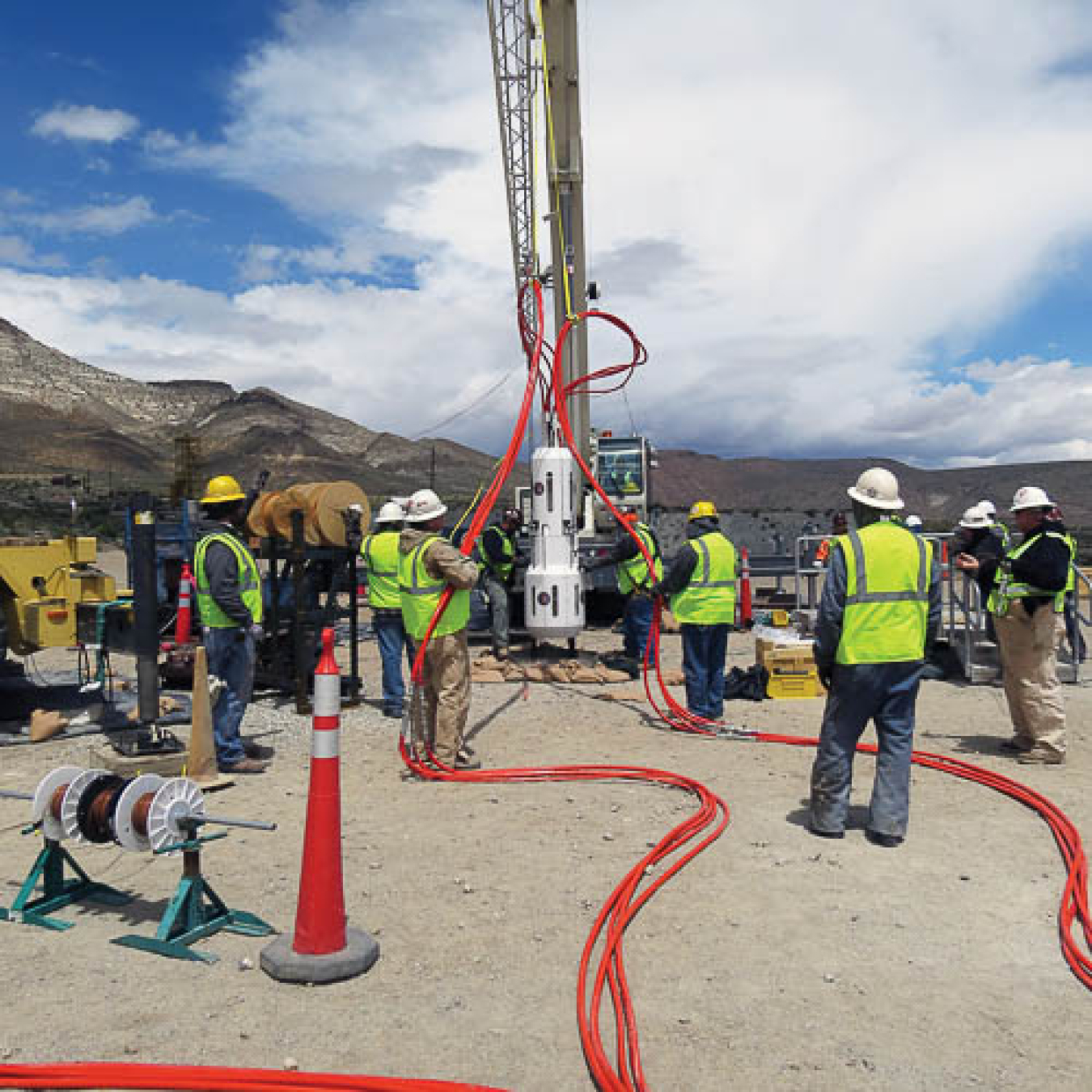
Workers at Nevada National Security Site prepare for a Source Physics Experiment to improve U.S. capability to detect and characterize underground nuclear explosions and help develop capability for monitoring low-yield nuclear testing.
NNSA advances its nuclear threat reduction mission by developing ways to detect and monitor foreign nuclear fuel cycle and weapons development activities, special nuclear material movement or diversion, and nuclear explosions. These same capabilities support nuclear arms control treaty monitoring and verification, operational interdiction and other nuclear security efforts across NNSA and the U.S. Government. This includes delivering space-based sensors to meet the nation’s operational nuclear test treaty monitoring obligations as well as its need to warn and give assessments of air, missile, and space threats. It also includes improving the speed, accuracy, confidence, and specificity of nuclear forensics analytic capabilities related to nuclear detonations.
Using the unique facilities and scientific skills of NNSA and Department of Energy’s national laboratories, and in partnership with industry and academia, R&D efforts provide the technical base for national and homeland security agencies to meet their nonproliferation, counterproliferation, and counterterrorism responsibilities.